
2026 Ford vehicles require routine engine oil changes every 7,500 to 10,000 miles, brake fluid replacements every 3 years, and automatic transmission fluid or coolant service between 100,000 and 150,000 miles under normal operating conditions. However, severe duty like frequent towing or heavy traffic requires accelerated schedules.
Adhering to factory-recommended intervals prevents premature wear on critical powertrain components. While modern Ford vehicles monitor oil life electronically, other essential systems—such as hydraulic brakes, cooling systems, transfer cases, and differentials—depend on mileage or time-based maintenance intervals. Ford guidelines recommend performing a monthly check of key fluid levels, including engine oil, coolant, windshield washer fluid, and brake fluid, to catch minor loss early.
Operating conditions in New England frequently qualify under Ford severe-duty guidelines. Driving in freezing winter conditions, navigating road salt, short-trip stop-and-go driving, or extended idling rapidly degrades chemical protective additives in vehicle fluids. For example, daily stop-and-go commuting around Framingham puts heightened thermal stress on transmission and engine oil compared to steady highway cruising. Under severe operating conditions, fluid service intervals for differentials, transfer cases, and transmissions should be reduced by roughly half to maintain thermal stability and gear protection.
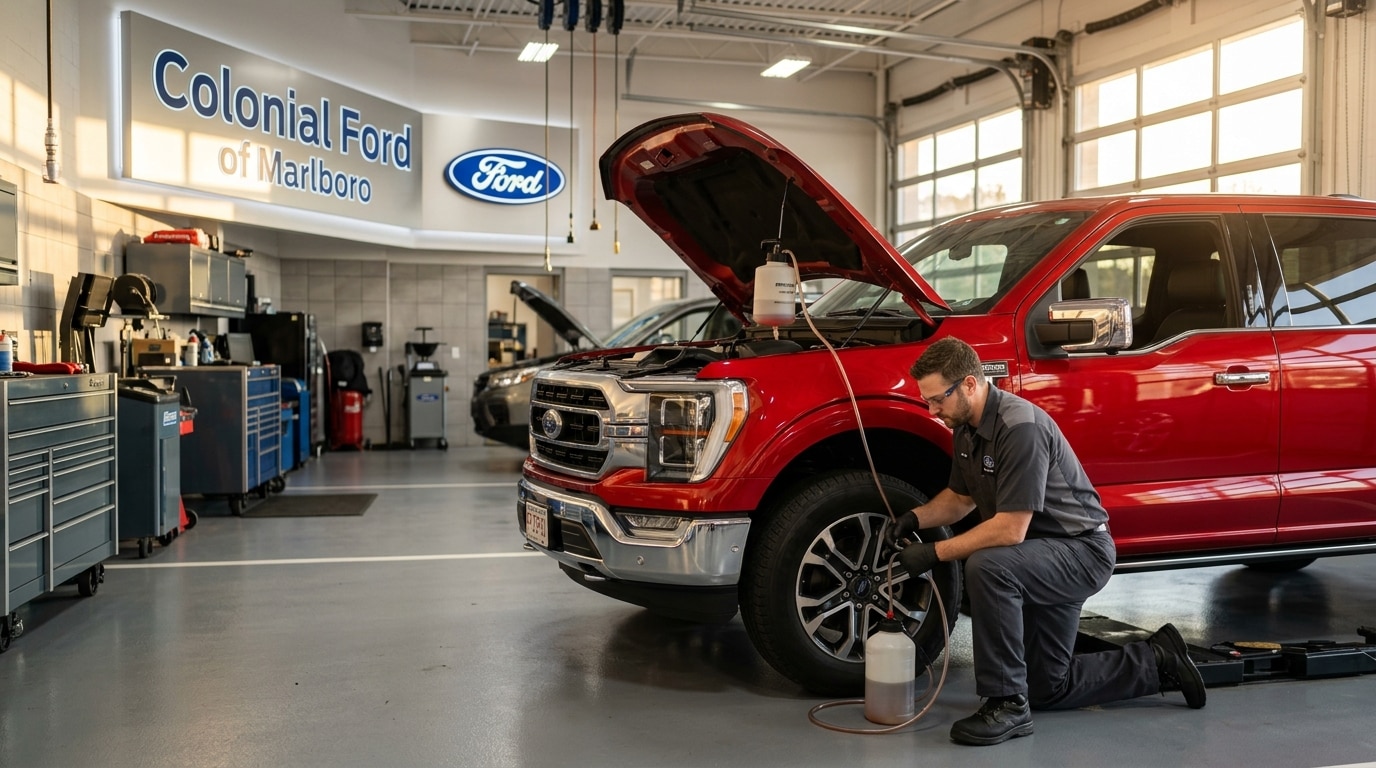
A complete vehicle inspection involves checking fluid levels, inspecting for active leaks, and evaluating fluid color and viscosity. When a fluid level drops unexpectedly, adding fresh fluid is only a temporary fix. Professional technicians look for underlying issues such as failing gaskets, cracked hoses, or loose fittings. To keep your vehicle running reliably, schedule an inspection at our Marlborough dealership location or give our service department a quick call to verify your recommended maintenance schedule.
Table of Contents
- What Is the Price Difference Between a Fluid Top-Up and a Complete System Flush?
- Can Mixing Fresh Fluid with Old Fluid Harm a Ford Engine or Transmission?
- How Do Service Technicians Check Fluid Levels on Sealed Ford 10-Speed Transmissions?
- Does Getting Fluid Service at an Independent Shop Void the Ford Factory Warranty?
- Quick Answers to Common Questions About Ford Fluid Top-Ups and Flushes
- Keep Your Ford Vehicle Running Smoothly with Expert Service
What Is the Price Difference Between a Fluid Top-Up and a Complete System Flush?
A fluid top-up typically costs between $20 and $40—and is often performed free during comprehensive multi-point inspections—whereas a complete system flush generally ranges from $150 to $350 or more depending on the specific fluid, capacity, and system complexity.
The price gap between these two services stems from the volume of fluid required, specialized equipment, and technician labor time. A fluid top-up involves adding small quantities—usually less than a quart—of fresh fluid directly into a reservoir to return low fluid levels to the proper indicator line. This quick procedure restores fluid volume but leaves the existing, oxidized fluid, along with suspended debris and thermal breakdown products, inside the system.
In contrast, a complete fluid exchange or flush uses professional equipment to purge virtually all old, degraded fluid from internal lines, heat exchangers, torque converters, or hydraulic passages. A complete transmission or cooling system flush requires several gallons of fresh, OEM-certified fluid to push out contaminated fluid completely. For example, performing a complete cooling system flush with Ford Yellow Prediluted Antifreeze/Coolant requires exchanging the full system volume, installing fresh protection additives, bleeding air pockets, and disposing of old hazardous chemical waste properly.
| Service Factor | Fluid Top-Up | Complete System Flush |
|---|---|---|
| Average Cost Range | $20 – $40 (or complimentary with inspection) | $150 – $350+ |
| Fluid Volume Used | Less than 1 quart | 2 to 4 gallons (100% replacement) |
| System Debris Removal | None (dilutes old fluid only) | High (purges sludge, varnish, & particulate) |
| Labor & Equipment Needed | Manual pour / basic check | Fluid exchange machine & system bleeding |
| Recommended Frequency | Monthly or during routine oil service | Time or mileage-based intervals ( 3 years / 100k miles) |
Topping off fluid is appropriate when adjusting for normal consumption or slight volume changes due to temperature drops. However, relying on top-ups when fluid is severely oxidized, discolored, or burnt will accelerate component wear. Fresh fluid added to a heavily contaminated system quickly loses its protective qualities as it mixes with residual debris.
Can Mixing Fresh Fluid with Old Fluid Harm a Ford Engine or Transmission?
Topping off a fluid reservoir with fresh fluid that meets the exact OEM specification is safe, but mixing non-compatible fluid grades or leaving heavily oxidized fluid in a system reduces thermal protection and accelerates mechanical wear.
Adding fresh fluid to severely aged fluid causes chemical degradation of the new mixture. Over time, engine oil, transmission fluid, and coolant lose their essential additives—including anti-wear agents, corrosion inhibitors, and friction modifiers. When new fluid is poured into a system filled with sludge, varnish, or suspended metallic particles, the remaining detergents in the fresh fluid break loose contamination without fully flushing it out. This loose particulate can clog narrow internal passages, solenoid valves, or oil galleries in modern Ford engines and transmissions.
Using incorrect fluid specifications during a top-up introduces serious mechanical risks. Mixing different coolant formulations can lead to chemical precipitation, creating a gel-like byproduct that blocks radiator cores and heater channels. For 2024 and newer Ford models, mixing legacy coolants with Ford Yellow Prediluted Antifreeze/Coolant (meeting specification WSS-M97B57-A2) ruins the extended-life corrosion protection engineered specifically for aluminum engine blocks and water pumps. In automatic transmissions, adding non-approved transmission fluid alters frictional properties, leading to torque converter shudder, clutch slippage, and harsh shifting.
How Do Service Technicians Check Fluid Levels on Sealed Ford 10-Speed Transmissions?
Service technicians check fluid levels on sealed Ford 10-speed transmissions using an under-vehicle dipstick location plug near the transmission case while monitoring real-time fluid temperature with a diagnostic scan tool to ensure it reaches 180°F to 200°F.
Modern Ford 10-speed automatic transmissions, such as the 10R80, do not feature a traditional dipstick under the hood. This sealed design prevents fluid contamination and ensures precise fill levels. Checking fluid levels on these units requires lifting the vehicle level on a hydraulic hoist. Because transmission fluid expands significantly as it heats up, obtaining an accurate measurement requires bringing the transmission to its exact operating temperature window between 180°F and 200°F.
Once the target temperature is verified via diagnostic scan tools, technicians wear protective heat gear to remove the knurled dipstick cap plug located on the side of the transmission case near the exhaust system. The integrated MINI-dipstick features distinct fill bands corresponding to specific fluid temperature ranges. If the fluid level reads low, technicians use specialized fluid pump equipment to add fluid matching Ford specifications until it reaches the correct indicator mark.
When drivers who haul utility trailers across the rolling hills of Stow visit for routine service, our technicians emphasize how crucial precise fluid levels are for heavy-duty cooling and gear longevity. To ensure your transmission operates within factory parameters, consider scheduling a service appointment for a complete multi-point fluid check.
Does Getting Fluid Service at an Independent Shop Void the Ford Factory Warranty?
Getting fluid service at an independent repair facility does not void your Ford factory warranty, provided the service uses fluids meeting Ford engineering specifications and complete maintenance records are retained.
Under federal law—specifically the Magnuson-Moss Warranty Act—vehicle manufacturers cannot void warranty coverage simply because maintenance was performed by an independent shop or by the owner. However, standard Ford factory warranties cover manufacturing defects and mechanical component failures rather than routine maintenance items like fluid top-ups, system flushes, or oil changes. To protect your factory warranty coverage, any fluid used must meet the precise technical specification listed in your Owner's Manual, such as specific Motorcraft lubricant standards.
Warranty claims may be denied if a component failure is directly caused by incorrect fluid, improper service procedures, or poor maintenance practices executed by an independent facility. For example, if an unapproved fluid grade causes internal seal failure in a transfer case, repairs to that transfer case will not be covered under the factory warranty. To avoid potential disputes, vehicle owners must keep detailed receipts showing service dates, mileage, part numbers, and fluid specifications.
Using dealership service eliminates warranty documentation risks. Factory-trained technicians use genuine Motorcraft fluids formulated specifically for Ford powertrains, ensuring all service complies with warranty standards. You can view our current service and parts specials to find competitive pricing on official Ford fluid maintenance.
Quick Answers to Common Questions About Ford Fluid Top-Ups and Flushes
Q: Does the Ford factory warranty cover routine fluid top-ups and flushes?
Standard Ford factory warranties cover mechanical component defects and assembly failures rather than routine maintenance tasks. Fluid top-ups, system flushes, and filter replacements are owner maintenance responsibilities, unless your vehicle is covered under an optional FordProtect Extended Service Plan that explicitly includes scheduled fluid maintenance items.
Q: What specific coolant type is required for 2024 and newer Ford vehicles?
2024 and newer Ford vehicles require Ford Yellow Prediluted Antifreeze/Coolant, which meets Ford engineering specification WSS-M97B57-A2. This organic additive technology (OAT) coolant provides extended-life corrosion protection for aluminum cylinder heads, engine blocks, and water pumps without creating abrasive silicate buildup inside radiator channels.
Q: What are the primary signs that Ford transmission fluid needs to be flushed?
Key indicators that transmission fluid has degraded include delayed gear engagement, slipping between gears, harsh upshifts, unexpected whining or clunking sounds under load, burnt-smelling or dark fluid, and fluid temperature warning alerts displayed on the instrument cluster screen.
Q: Is a brake fluid flush necessary if my brake pedal still feels firm?
Yes, a brake fluid flush is necessary because glycol-based brake fluid absorbs atmospheric moisture over time regardless of pedal feel. Accumulated water drops the boiling point of the fluid—increasing the risk of brake fade under heavy load—and accelerates internal oxidation inside expensive anti-lock brake system (ABS) hydraulic control modules. Ford recommends replacing brake fluid every 3 years.
Q: What happens if a technician discovers low fluid during a routine top-up check?
When a technician finds low fluid levels, they top off the system and conduct a visual diagnostic inspection of hoses, fittings, water pumps, radiator seams, or drivetrain seals. Automotive fluid circuits are closed systems, meaning low levels typically signal a mechanical slow leak or fluid consumption issue that requires technical evaluation.
Keep Your Ford Vehicle Running Smoothly with Expert Service
Maintaining clean, high-grade fluids is essential for protecting your engine, transmission, and braking systems against premature wear and high-cost mechanical repairs. Whether your vehicle requires a basic fluid inspection or a complete fluid exchange, utilizing OEM-certified Motorcraft fluids ensures your powertrain operates exactly as Ford engineers intended.
Our team at Colonial Ford of Marlboro provides factory-trained expertise, advanced diagnostic tools, and genuine Ford fluids tailored to your vehicle's exact maintenance schedule. Visit our Marlborough dealership address today, or contact our service team at (508) 460-8400 to set up your next fluid inspection and keep your Ford running at peak performance.
© 2026 Colonial Ford of Marlboro. All rights reserved.