
Most gasoline engines in the Ford F-150 require SAE 5W-30 or SAE 5W-20 engine oil meeting Ford engineering specification WSS-M2C961-A1 or updated specification WSS-M2C971-A1. Ford recommends using Motorcraft synthetic blend or full synthetic motor oil formulated to protect high-output EcoBoost turbochargers, prevent low-speed pre-ignition, and maintain full 5-year/60,000-mile powertrain warranty coverage.
Engine oil plays a critical role in preserving engine performance, managing internal friction, and cooling high-temperature components like turbocharger bearings. Ford powertrains are engineered alongside specific chemical additive packages. Oils meeting the WSS-M2C961-A1 standard comply with API SP and ILSAC GF-6 standards, which prevent harmful carbon deposits from building up on intake valves and turbocharger oil lines.
When selecting an engine oil grade, matching the exact viscosity to the specific engine design is essential. Ford specifies SAE 5W-30 for EcoBoost twin-turbo V6 engines and the PowerBoost hybrid powertrain, while certain naturally aspirated engines specify SAE 5W-20 or SAE 5W-30 depending on the specific model year. While synthetic blend oil provides excellent protection under standard driving conditions, full synthetic oil delivers enhanced shear stability and cold-flow properties during severe New England winters.
Every engine oil service must also include a factory-spec oil filter replacement, such as the Motorcraft FL-500-S filter. OEM filters feature anti-drainback valves that maintain oil pressure during cold starts and pressure-relief valves designed specifically for Ford oil pump flow rates. Drivers seeking maintenance guidance can visit our service center location or call (508) 460-8400 to speak with a factory-trained technician.
Table of Contents
- How Often Should a Ford F-150 Get an Oil Change?
- What Are the Engine Options and Oil Capacities for the Ford F-150?
- What Happens If You Delay a Ford F-150 Oil Change Past Recommendations?
- How Do You Reset the Oil Life Monitor on a Ford F-150?
- Which Maintenance Practices Help Preserve Maximum Truck Resale Value?
- Common Questions About Ford F-150 Maintenance and Oil Service
- Where Can You Get Authorized Ford F-150 Oil Change Service Near Framingham?
How Often Should a Ford F-150 Get an Oil Change?
Under normal operating conditions, the 2026 Ford F-150 in Marlborough requires an engine oil change every 7,500 to 10,000 miles or every 6 to 12 months, guided by the onboard Intelligent Oil-Life Monitor. For trucks operated under severe duty conditions—such as frequent trailer towing, extended idling, or low-speed driving in freezing temperatures—the service interval reduces to 5,000 to 7,500 miles.
The Intelligent Oil-Life Monitor continuously calculates remaining oil viability based on real-time engine data rather than simple odometer mileage. Algorithm inputs include engine operating temperatures, total engine revolutions, vehicle load, idling duration, and ambient weather conditions. When the remaining fluid life reaches 15 percent, the instrument cluster displays an alert prompting the driver to schedule service before thermal breakdown occurs.
Driving habits in New England often classify trucks into severe duty maintenance schedules. For truck owners in Stow operating near conservation lands and unpaved access routes, low ambient temperatures combined with frequent short trips prevent motor oil from reaching optimal operating temperatures above 180 degrees. Cold engine operation allows raw fuel and condensation to accumulate in the oil pan, diluting fluid viscosity and accelerating engine wear.
Following recommended service intervals ensures that vital additive packages—such as detergent dispersants, anti-wear agents, and corrosion inhibitors—remain active. Adhering to factory oil change intervals safeguards internal timing components and preserves factory warranty protection for the lifetime of the truck.
What Are the Engine Options and Oil Capacities for the Ford F-150?
Engine oil capacities for the Ford F-150 range from 6.0 quarts for V6 powertrains up to 11.5 quarts for high-performance supercharged V8 engines. Verifying the specific engine code and oil dipstick capacity is vital, as overfilling or underfilling can cause oil aeration, improper crankcase pressure, and component wear.
The Ford F-150 engine lineup features multiple displacement choices designed for distinct work and performance demands:
- 2.7L EcoBoost V6: Requires 6.0 quarts of SAE 5W-30 oil.
- 3.5L EcoBoost V6: Requires 6.0 quarts of SAE 5W-30 oil.
- 3.5L PowerBoost Hybrid V6: Requires 6.0 quarts of SAE 5W-30 oil.
- 5.0L Coyote V8: Requires 7.75 quarts of SAE 5W-30 or SAE 5W-20 oil.
- 5.2L supercharged V8: Requires 11.5 quarts of full synthetic oil.
Turbocharged EcoBoost engines rely on precise oil circulation to cool turbocharger turbine shafts operating at extreme rotational speeds. The 3.5L PowerBoost Hybrid V6 integrates electrical assist with twin-turbocharging, demanding synthetic lubricants that maintain film strength during rapid engine start-stop cycles.
The naturally aspirated 5.0L Coyote V8 features dual independent variable camshaft timing (Ti-VCT), utilizing hydraulic oil pressure actuators to advance or retard valve timing. Maintaining correct oil level and clean fluid prevents valve timing lag and preserves engine power.
| Engine Option | Recommended Viscosity | Specification Standard | Crankcase Capacity |
|---|---|---|---|
| 2.7L EcoBoost V6 | SAE 5W-30 | WSS-M2C961-A1 | 6.0 Quarts |
| 3.5L EcoBoost V6 | SAE 5W-30 | WSS-M2C961-A1 | 6.0 Quarts |
| 3.5L PowerBoost Hybrid V6 | SAE 5W-30 | WSS-M2C961-A1 | 6.0 Quarts |
| 5.0L Coyote V8 | SAE 5W-30 / SAE 5W-20 | WSS-M2C961-A1 | 7.75 Quarts |
| 5.2L supercharged V8 | SAE 5W-50 / SAE 5W-30 | Factory Full Synthetic | 11.5 Quarts |
What Happens If You Delay a Ford F-150 Oil Change Past Recommendations?
Delaying a Ford F-150 oil change causes chemical oil oxidation, engine sludge formation, and accelerated wear on critical moving parts. Over time, degraded oil loses its ability to lubricate internal components, leading to increased engine friction, overheating, and potential voiding of factory warranty coverage.
As motor oil ages, high heat breaks down synthetic base stock and consumes active detergent additives. In direct-injection EcoBoost engines, degraded oil forms carbon varnish along high-temperature turbocharger oil supply lines. Restricting oil flow to turbo bearings leads to seal failure, shaft play, and costly assembly replacements.
Old fluid also carries unburned fuel soot, road debris, and combustion byproducts in suspension. When saturation limits are exceeded, sludge settles inside oil passages, hydraulic lifters, and variable valve timing solenoids. Sludge buildup disrupts oil pressure, causing valve train clatter and timing chain stretch.
Operating past service limits also increases the risk of low-speed pre-ignition (LSPI), where combustion chamber deposits trigger premature fuel ignition that can damage pistons and connecting rods. Adhering to scheduled maintenance intervals protects major mechanical systems and preserves factory warranty protections.
How Do You Reset the Oil Life Monitor on a Ford F-150?
Resetting the Intelligent Oil-Life Monitor on a Ford F-150 requires accessing the Vehicle Maintenance screen on the digital instrument cluster and holding the OK button until the system resets to 100 percent. Resetting should occur only after performing a complete fluid change with fresh motor oil and a new OEM filter.
To complete the manual reset procedure:
- Turn the ignition switch to the ON position without starting the engine (for push-button start vehicles, press the START button without depressing the brake pedal).
- Use the main steering wheel directional control pad to navigate through the main screen menu.
- Select Settings, scroll down to Vehicle Maintenance, and select Oil Life.
- Press and hold the OK button on the steering wheel until the display bar fills completely and indicates Oil Life 100%.
- Turn the ignition OFF to store the updated setting in the engine control module.
Resetting the system without replacing the engine oil misleads the control module algorithms. The monitor will calculate fluid breakdown based on fresh oil assumptions while degraded fluid remains in the crankcase, increasing the risk of mechanical damage.
Which Maintenance Practices Help Preserve Maximum Truck Resale Value?
Documenting every scheduled fluid service, utilizing genuine OEM parts, and maintaining complete electronic maintenance records preserves peak truck resale value over time. Comprehensive maintenance logs demonstrate proper care to prospective buyers and vehicle appraisers.
Key maintenance practices that preserve pre-owned market value include:
- Documented Factory Service History: Logging every oil service, tire rotation, and multi-point inspection within centralized Ford dealer network databases proves adherence to recommended service intervals.
- Genuine OEM Components: Installing original Motorcraft FL-500-S filters, factory air filters, and approved synthetic lubricants ensures original engineering standards are maintained.
- Preventative Fluid Flushing: Servicing transfer case fluids, differential lubricants, and transmission fluids at specified mileage thresholds prevents premature driveline wear.
- Undercarriage & Bed Protection: Cleaning road salt accumulation from frame rails during New England winter months prevents surface corrosion, while installing drop-in or spray-in bed liners shields truck beds from cargo damage.
Truck buyers prioritize vehicles with complete service records, consistent maintenance logs, and leak-free engine bays. Following regular service schedules protects core mechanical reliability and yields higher trade-in returns.
Common Questions About Ford F-150 Maintenance and Oil Service
Q: Is full synthetic oil required for all Ford F-150 engines?
Full synthetic oil is recommended for high-output applications like the 5.2L supercharged V8, while Ford approves both synthetic blend and full synthetic oils for EcoBoost V6 and Coyote V8 engines. Synthetic blend oil meets factory specifications for everyday driving, but full synthetic motor oil provides superior high-temperature oxidation resistance, reduced turbocharger carbon deposits, and faster oil flow during cold starts.
Q: What is the difference between severe duty and normal duty maintenance schedules?
Normal duty service applies to everyday highway and suburban commuting under moderate temperatures, requiring oil changes every 7,500 to 10,000 miles. Severe duty maintenance applies when trucks experience frequent commercial towing, heavy payload hauling, extensive idling, off-road driving, or prolonged operation in below-freezing weather. Severe duty requires fluid changes every 5,000 to 7,500 miles to flush away soot and unburned fuel.
Q: Why does engine oil turn dark quickly in EcoBoost powertrains?
Direct-injection gasoline engines spray high-pressure fuel directly into combustion chambers, generating small carbon soot particles during ignition. EcoBoost oil formulations hold these fine carbon particles in suspension to prevent them from settling onto internal engine surfaces. Darkened oil indicates that detergent additives are actively trapping contaminants and cleaning internal engine passages.
Q: Can aftermarket oil filters void my Ford factory powertrain warranty?
Using an aftermarket filter does not automatically void warranty coverage, but using non-compliant filters that fail, lack anti-drainback protection, or restrict oil flow can lead to denied claims if engine damage occurs. Factory Motorcraft FL-500-S filters feature exact bypass valve pressure calibrations and anti-drainback seals designed specifically for Ford oil pump specifications.
Q: Does the Ford F-150 PowerBoost hybrid need fewer oil changes than non-hybrid trucks?
The 3.5L PowerBoost Hybrid V6 follows the same 7,500 to 10,000-mile max oil change interval guided by the Intelligent Oil-Life Monitor. While the electric motor handles light loads, frequent engine starting and stopping can create thermal cycles that cause moisture condensation inside the crankcase. Following monitor alerts ensures proper oil protection regardless of engine run-time ratios.
Where Can You Get Authorized Ford F-150 Oil Change Service Near Framingham?
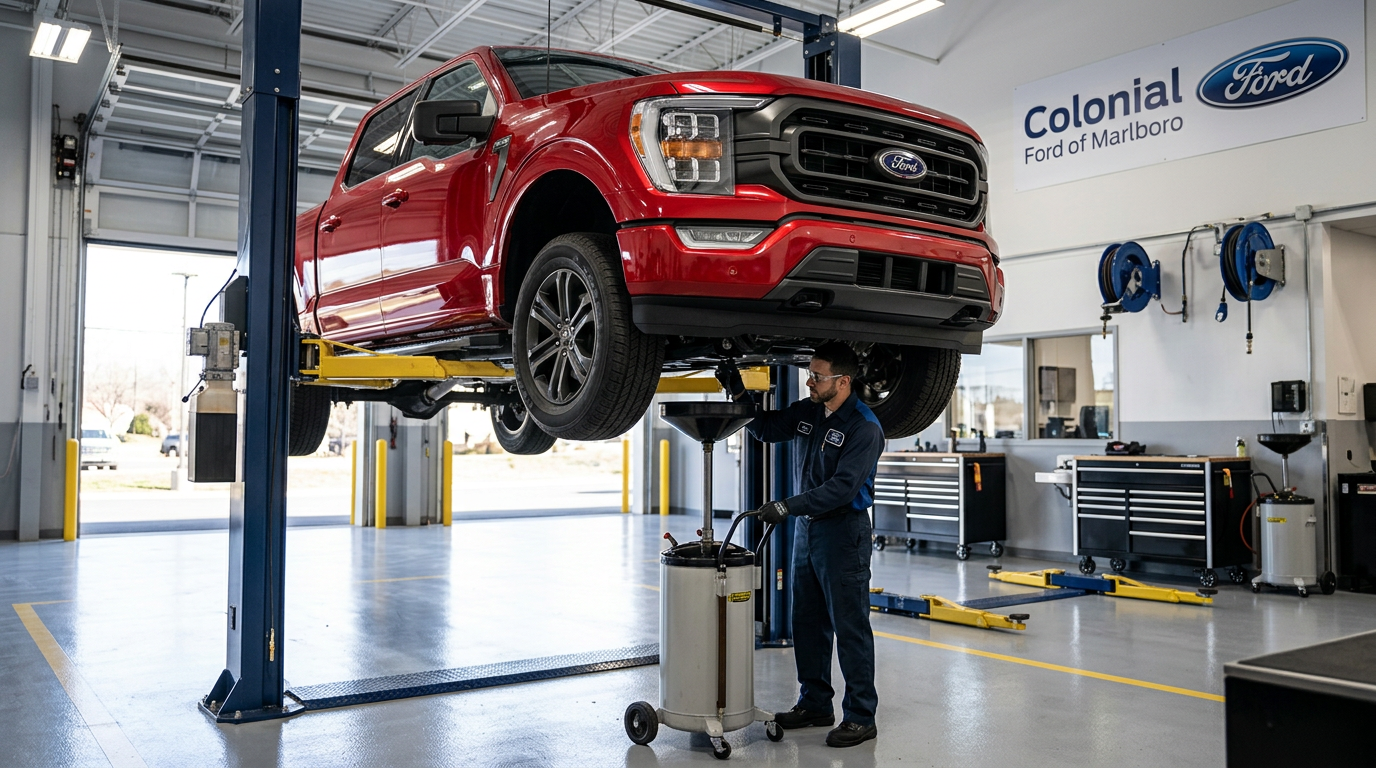
Authorized Ford F-150 oil change service is available at Colonial Ford of Marlboro, where certified technicians install factory-approved synthetic lubricants and genuine OEM filters. Our dedicated service facility utilizes advanced diagnostic tools to inspect engine systems, check active service bulletins, and maintain factory warranty protection.
For commuters driving from Framingham along Route 9 or Interstate 90, maintaining scheduled oil service at our Marlborough service center provides quick access to factory-trained truck specialists. Every service visit includes a multi-point inspection examining brake lining thickness, tire tread depth, battery health, and engine air filter conditions to keep your truck performing at its peak.
To maintain your truck's mechanical performance and long-term value, contact our service team at (508) 460-8400 or reserve your next appointment by scheduling your service appointment online today.
© 2026 Colonial Ford of Marlboro. All rights reserved.