

Essential Care for the 2026 Ford 12-Volt Battery System
The 12-volt battery remains a critical component in the 2026 Ford lineup, serving as the heartbeat for essential electronics even in fully electric models. While high-voltage traction packs provide the propulsion for EVs, the smaller 12-volt unit manages the vehicle's computer modules, safety sensors, and lighting systems. In gasoline-powered models like the 2026 Ford F-150, this battery must also deliver the 760 cold cranking amps required to turn over a 5.0L V8 engine during a cold morning. Without a healthy 12-volt charge, even a fully fueled or fully charged vehicle may fail to enter its "Ready" mode because the electrical contactors require this low-voltage power to engage.
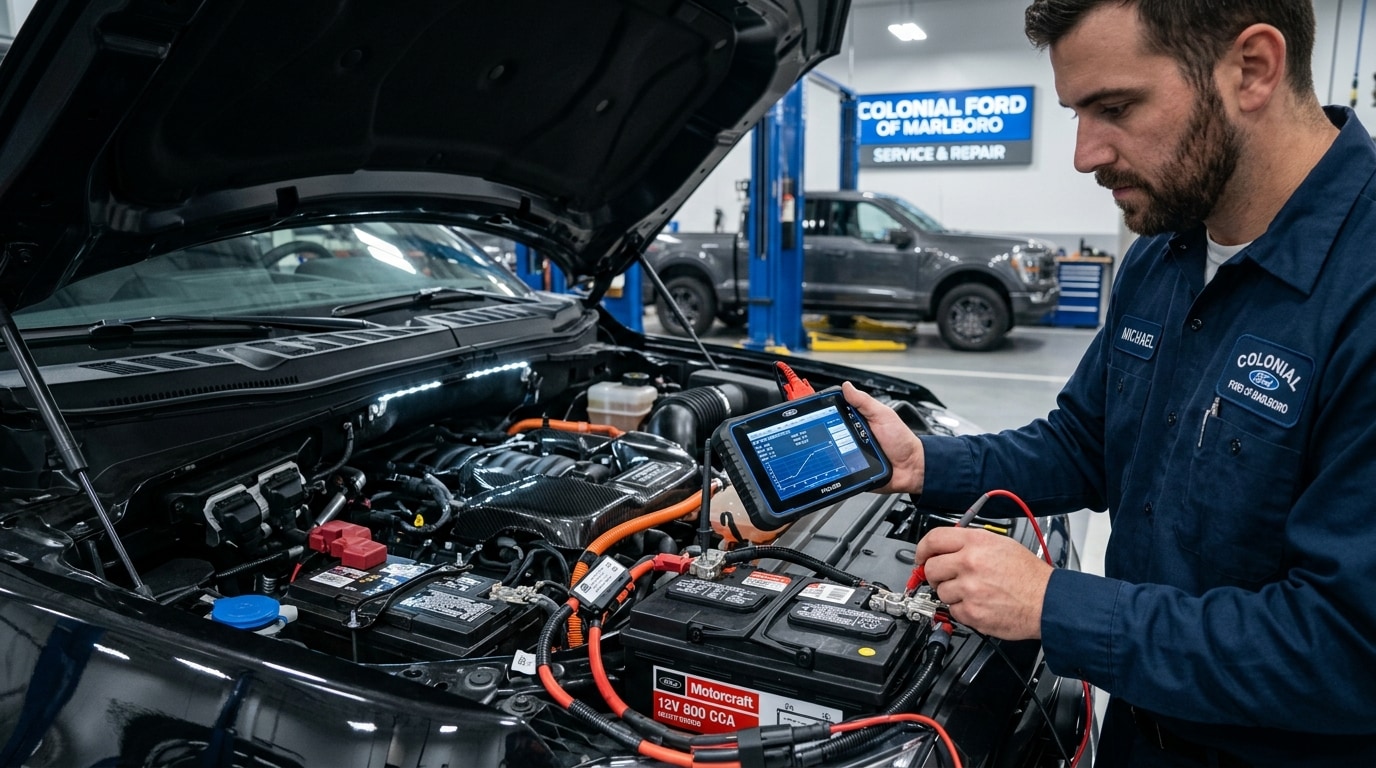
Maintaining this system involves more than just checking for a successful start. Modern Ford vehicles utilize sophisticated charging logic that adjusts based on the battery's age and health. If you notice your vehicle is slow to respond to keyless entry or if the infotainment screen takes longer than usual to boot up, it may be time to book a professional inspection with our certified technicians. We use factory-grade diagnostic tools to verify that your battery meets the specific requirements of your model, ensuring that every module from the BlueCruise hardware to the climate control functions as intended.
For those who do not drive their vehicles daily, Ford recommends starting and moving the vehicle at least once every 30 days to maintain the health of the 12-volt system. If your vehicle will be stationary for longer periods, using a battery maintainer can prevent the deep discharges that often lead to premature failure. If you are unsure about the best maintenance strategy for your specific model, you can reach us at (508) 460-8400 for expert guidance. For local drivers looking to visit us in person, our Marlborough service center is conveniently located to handle everything from routine testing to OEM battery replacements.
Table of Contents
- New England Environmental Impacts on 12-Volt Battery Lifespan
- Identifying Warning Signs of 12-Volt Battery Degradation
- Professional Diagnostics and Home Testing for Battery Health
- Proactive Seasonal Maintenance and Winter Readiness Strategies
- Common Questions Regarding Ford 12-Volt Battery Service
- Protecting Your Vehicle Reliability with Expert Battery Care
New England Environmental Impacts on 12-Volt Battery Lifespan
Drivers in Framingham often face a unique set of challenges when it comes to battery longevity due to the volatile climate of the region. The chemical reactions inside a lead-acid or AGM battery are highly sensitive to temperature extremes. While summer heat often accelerates the internal degradation of the battery plates, it is the arrival of sub-freezing temperatures that typically reveals the damage. In cold-winter zones, a battery can lose a significant portion of its effective cranking power as the internal resistance increases, making it much harder to start a heavy-duty engine like the one found in a 2026 Ford Explorer.
The local environment also introduces the factor of road salt and high humidity. In this salt-belt region, corrosion can quickly build up on battery terminals and grounding points. This white, powdery oxidation acts as an insulator, resisting the flow of electricity and forcing the alternator to work harder to keep the battery charged. Over time, this extra strain can shorten the life of the charging system components. We typically see 12-volt batteries in our area last between three and five years, though frequent short trips—where the alternator doesn't have enough time to fully replenish the charge—can push that lifespan toward the lower end of the scale.
For owners of hybrid and electric models, the 12-volt battery faces a different kind of stress. These vehicles often use an Absorbent Glass Mat (AGM) battery, which is designed to handle frequent cycling and provide stable power to the vehicle's "always-on" connectivity features. However, even these advanced units are susceptible to the deep-freeze cycles common in Massachusetts. Ensuring that your vehicle's software is kept up to date through Ford Power-Up updates is vital, as these updates often include refinements to how the vehicle manages its 12-volt power reserves during extreme weather events.
Identifying Warning Signs of 12-Volt Battery Degradation
Does your vehicle seem to "struggle" for a split second before the engine catches? This momentary hesitation is often the first audible sign that the battery is losing its ability to hold a sufficient charge. In gasoline models, you might notice the starter motor sounds more sluggish than usual. In electrified models, the signs are often more subtle and digital. You might receive a "System Off to Save Battery" message on your dashboard, or notice that the interior lights flicker slightly when the vehicle is first powered on. Because the 12-volt battery supports the vehicle's computers, a failing unit can sometimes trigger a cascade of unrelated warning lights or "ghost" errors in the safety systems.
Physical inspections can also reveal a battery in distress. If you open the hood and notice a bulging or "swollen" battery case, it is a sign that the battery has been overcharged or exposed to extreme heat, and it should be replaced immediately to avoid a leak. Similarly, the presence of a rotten-egg smell indicates that the battery is venting gas, which usually happens when it is failing internally. Our team recommends checking the battery terminals during every oil change; if you see a buildup of blue or white crust, the connection is being compromised, which prevents the battery from receiving a full charge from the alternator.
Another common indicator is the erratic behavior of accessory features. If your heated seats take longer to warm up or if the power liftgate on your 2026 Ford Escape operates more slowly than it used to, the 12-volt system may be struggling to meet the demand. Modern Ford vehicles are equipped with an Intelligent Battery Sensor that monitors the state of charge and health. When this sensor detects that the battery is no longer reliable, it may proactively disable non-essential features like the Auto Start-Stop system to preserve enough power to keep the engine running.
Professional Diagnostics and Home Testing for Battery Health
Many owners ask if they can accurately gauge their battery's health using a simple handheld voltmeter at home. While a voltmeter can tell you the resting voltage—ideally around 12.6 volts for a fully charged unit—it does not measure the battery's ability to handle a load. A battery might show a healthy voltage on the surface but "collapse" the moment it is asked to provide the high amperage needed for a cold start. Professional-grade testers used by our technicians perform a conductance test, which provides a much clearer picture of the battery's internal structure and its remaining cold cranking amps (CCA).
When a battery is replaced in a 2026 Ford, the process involves more than just swapping the physical unit. These vehicles utilize a Battery Management System (BMS) that tracks the age and performance characteristics of the battery. As a battery ages, the BMS changes the charging profile to compensate for wear. If a new battery is installed without resetting the BMS, the computer will continue to charge the new unit as if it were an old, degraded one. This can lead to overcharging and significantly shorten the life of your new investment. Our service team performs this factory-required diagnostic reset as part of every battery installation.
We also use specialized equipment to check for "parasitic draw," which occurs when a computer module fails to go to sleep after the vehicle is turned off. This is particularly important for hybrid models, where a software logic issue could potentially allow a brake pad self-adjustment routine or a connectivity module to continue drawing power while the vehicle is parked. By identifying these electrical leaks early, we can often prevent a situation where a perfectly good battery is repeatedly drained to the point of failure.
Proactive Seasonal Maintenance and Winter Readiness Strategies
Preparing for the winter months in Stow requires a proactive approach to electrical health. We recommend that any battery older than three years undergo a comprehensive load test before the first major cold snap arrives. Because cold weather can reduce a battery's capacity by up to 50 percent, a unit that performed adequately in September might fail completely by December. If your battery is nearing the end of its expected lifespan, replacing it on your own terms is far more convenient than dealing with a "no-start" situation in a snowstorm.
For those driving the 2026 Ford F-150, we often suggest the Heater, Engine Block option for those who park outdoors during the coldest months. By keeping the engine block warm, you reduce the initial load required by the starter motor, which in turn places less stress on the 12-volt battery. Additionally, keeping your vehicle's software current is a vital part of modern maintenance. Ford's warranty guidelines emphasize the importance of completing Power-Up software updates within a reasonable timeframe, as these often contain critical fixes for power management and battery longevity.
Routine cleaning is another simple but effective strategy. A clean battery top prevents "stray current" from tracking across the dirt and discharging the battery over time. Our technicians use specialized cleaners and terminal protectors to seal the connections against the corrosive effects of New England road salt. If you frequently drive on the unpaved back roads common in more rural areas, regular inspections are even more important to ensure that vibrations haven't loosened the battery hold-down brackets or terminal clamps.
Common Questions Regarding Ford 12-Volt Battery Service
Q: Does my Ford EV still have a regular 12-volt battery if it has a massive traction pack?
Yes, even the most advanced electric models utilize a 12-volt AGM battery to power the vehicle's control modules, lights, and infotainment. This battery is essential because it acts as the "key" that tells the high-voltage system when it is safe to engage. If this small battery dies, the vehicle will not start, regardless of how much energy is in the main traction pack.
Q: Why does Ford recommend a specific Motorcraft battery rather than a generic alternative?
Ford engineers design the vehicle's charging algorithms specifically for the internal resistance and chemistry of Motorcraft batteries, such as the Group Size 48 units found in many 2026 models. Using a battery with different specifications can confuse the Battery Management System, leading to improper charging and a shorter lifespan for the battery. You can often find current maintenance offers that make choosing the OEM-recommended part a cost-effective decision.
Q: How long should I expect my battery to last if I mostly drive short distances?
Frequent short trips are actually harder on a battery than long highway drives. The alternator needs time to replenish the energy used to start the engine; if the drive is too short, the battery remains in a partially discharged state. Over time, this leads to "acid stratification" and permanent loss of capacity. If your commute is short, we recommend a longer drive once a week or using a dedicated battery maintainer.
Q: Is jump-starting a 2026 Ford different from older vehicles?
While the basic concept is the same, many newer models have specific jump-start points located away from the battery itself to protect sensitive electronics. For example, on certain electrified models, these points are accessible via a small door in the front trunk area. Always refer to your owner's manual or contact our service department before attempting to jump-start to avoid damaging the vehicle's computer modules.
Protecting Your Vehicle Reliability with Expert Battery Care
Reliability on the road starts with a healthy electrical system. Whether you are navigating the daily commute or preparing for a weekend getaway, a well-maintained 12-volt battery ensures that your Ford's advanced safety and performance features are ready when you need them. Our team is dedicated to providing the technical expertise and genuine parts required to keep your vehicle performing at its peak through every season. If you have concerns about your vehicle's starting performance or electrical health, visit our Marlborough location for a comprehensive evaluation. You can also give us a quick call to speak with a service advisor about your maintenance needs. At Colonial Ford of Marlboro, we are here to help you stay on the move with confidence.
© 2026 Colonial Ford of Marlboro. All rights reserved.