

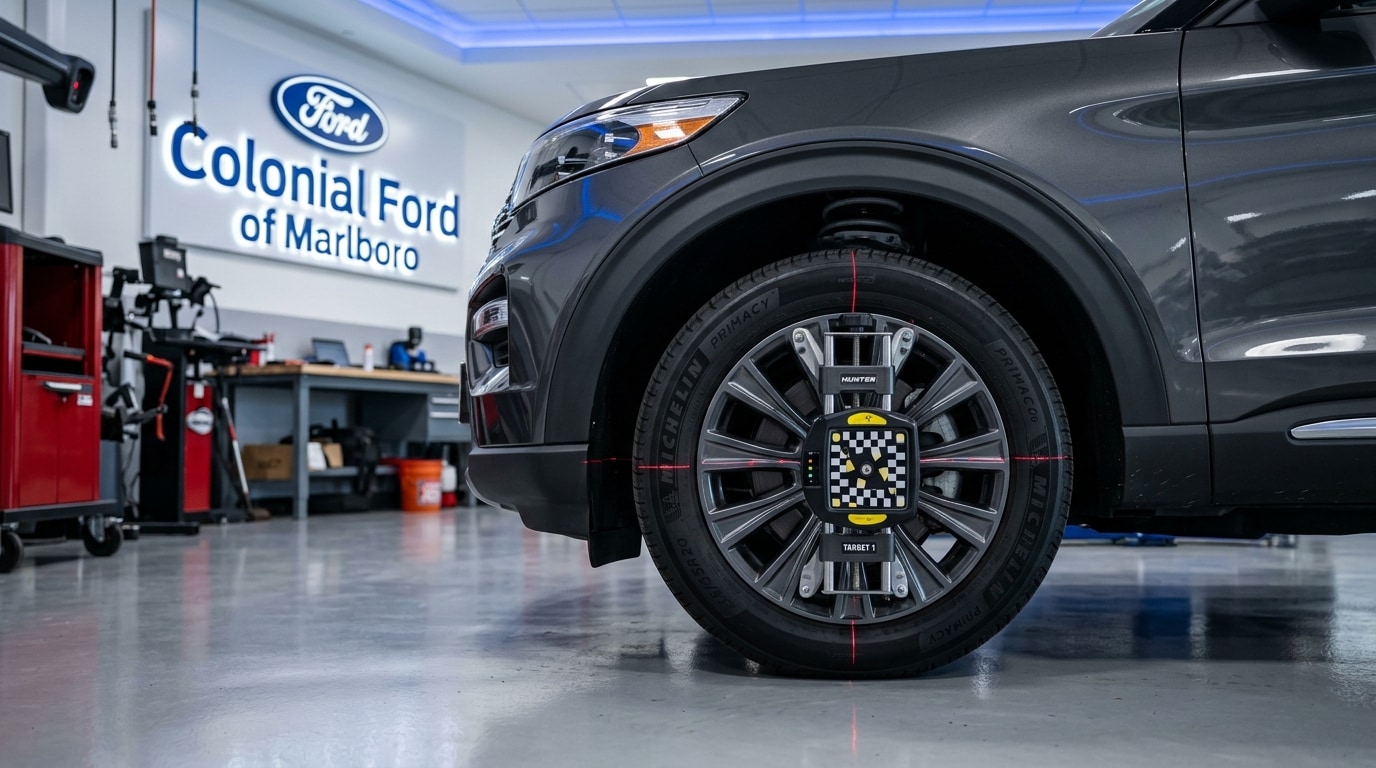
A 2026 Ford wheel alignment service involves measuring and precisely adjusting three primary suspension angles— toe, camber, and caster—to original factory specifications using computerized laser diagnostic equipment. Certified technicians inspect steering linkages, ball joints, control arms, and tire tread depth, center the steering wheel, test-drive the vehicle, and recalibrate Advanced Driver Assistance Systems (ADAS) sensors associated with Ford Co-Pilot360 when required.
Modern Ford vehicles feature sophisticated suspension geometry designed to deliver precise handling, maximum tire life, and optimal fuel economy. During a full alignment procedure, our factory-trained service team mounts high-definition optical targets to each wheel. A computerized alignment system measures the current orientation of your wheels down to fractions of a degree and compares those angles against Ford alignment specifications for your specific year, model, and trim.
The physical adjustment phase focuses on three fundamental alignment angles:
- Toe: The directional angle at which the tires point inward or outward when viewed from above. Incorrect toe alignment is the leading cause of rapid, uneven tire wear.
- Camber: The inward or outward tilt of the wheel when viewed from the front of the vehicle. Out-of-spec camber causes heavy tread wear on the inner or outer edge of the tire.
- Caster: The forward or backward slope of the steering axis when viewed from the side. Caster affects straight-line stability and steering wheel returnability.
On newer Ford models equipped with driver-assist technologies such as Lane-Keeping System, Adaptive Cruise Control, and Pre-Collision Assist, alignment adjustments alter the zero-point baseline of the steering angle sensor. Technicians perform an electronic recalibration to align the forward-facing radar and windshield-mounted cameras with the newly adjusted mechanical thrust line of the vehicle.
Before making structural adjustments, our team conducts a thorough visual and mechanical inspection of undercarriage components, checking tie rod ends, control arm bushings, strut mounts, and wheel bearings for wear. If you suspect your vehicle is drifting or exhibiting unusual wear, you can start by scheduling a service appointment online, giving our team a quick call, or visiting our service center in Marlborough at 428 Maple St.
Table of Contents
- How Often Does a Ford Vehicle Need a Wheel Alignment?
- What Is Included in a Ford Wheel Alignment vs. Wheel Balancing?
- Is Camber Correction Included in a Standard Ford Wheel Alignment?
- What Factors Affect Ford Wheel Alignment Costs and Pricing in Middlesex County?
- Do You Need an Appointment for a Ford Alignment?
- Common Questions About Ford Wheel Alignment Service
How Often Does a Ford Vehicle Need a Wheel Alignment?
A Ford vehicle generally needs a wheel alignment check once a year or roughly every 12,000 to 15,000 miles, as well as whenever you install new tires or complete suspension repairs. Vehicles subjected to harsh road conditions, frequent pothole strikes, or heavy towing benefit from inspections every 6 to 12 months or approximately every 30,000 miles for comprehensive four-wheel adjustments.
For daily commuters navigating frost-heaved pavement and pothole-ridden stretches along Route 9 through Framingham, seasonal temperature swings and rough road surfaces accelerate suspension displacement. Deep potholes, hidden curb impacts, and rutted asphalt can knock steering linkages out of specification instantly, even on brand-new vehicles.
When truck and SUV owners bring their vehicles in for routine service, they often ask whether a full four-wheel alignment is necessary every single year or only after replacing tires. Our service technicians walk them through tire tread wear patterns to demonstrate how slight misalignment scrub wears down tire shoulders long before driving drift becomes noticeable at the wheel.
Several key indicators signal that your vehicle requires an immediate alignment inspection:
- The vehicle pulls or drifts to one side when driving on a straight, level road.
- The steering wheel sits off-center when traveling straight ahead.
- You notice abnormal, feathered, or uneven tread wear across the inner or outer edges of your tires.
- The steering wheel exhibits a subtle vibration or feels loose at highway speeds.
Ignoring these early warning signs accelerates tire degradation and strains steering gear, shocks, and ball joints. If severe pothole impacts cause sudden drift or component damage while on the road, drivers covered by manufacturer protection can rely on Ford Roadside Assistance: 1-800-241-3673 for flat tire assistance or emergency towing to an authorized service facility.
What Is Included in a Ford Wheel Alignment vs. Wheel Balancing?
Wheel alignment adjusts suspension angles to ensure tires contact the road at factory-specified geometric positions, whereas wheel balancing corrects weight distribution imbalances across the tire-and-wheel assembly using small calibrated weights. Alignment resolves directional pulling and uneven tread wear, while wheel balancing eliminates high-speed rotational vibrations felt through the steering wheel or vehicle floor.
| Service Aspect | Wheel Alignment | Wheel Balancing |
|---|---|---|
| Primary Focus | Suspension geometry and directional angles | Weight symmetry of the tire-and-wheel assembly |
| Key Measurements | Toe, camber, and caster angles | High-speed rotational force and dynamic imbalance |
| Primary Corrective Action | Adjusting tie rods, control arms, and eccentric bolts | Attaching adhesive or clip-on wheel weights |
| Typical Symptoms Solved | Vehicle pulling, off-center steering wheel, edge wear | Steering wheel shaking or floorboard vibration at speed |
| Service Interval | Annually, or every 12,000 to 15,000 miles | Every 5,000 to 7,500 miles with tire rotations |
While both services protect your tires and optimize ride quality, they address distinct mechanical issues. Wheel balancing mounts the tire assembly onto a motorized balancer that spins the wheel to detect high spots and heavy areas. The machine calculates the exact mass and placement of counterweights needed to achieve smooth rotation.
In contrast, a four-wheel alignment does not remove the wheels from the vehicle. Instead, it adjusts the mechanical connections between the vehicle frame and suspension components. Combining regular tire rotations and balancing every 5,000 to 7,500 miles with an annual wheel alignment check provides comprehensive protection against premature tire replacement.
Is Camber Correction Included in a Standard Ford Wheel Alignment?
Camber correction is included in a standard Ford wheel alignment for factory-height vehicles equipped with stock suspension components in good operating condition. If suspension parts are worn or if aftermarket modification kits alter factory ride height beyond stock adjustment limits, specialized hardware or additional labor may be required to bring camber back into specification.
Camber refers to the inward or outward vertical angle of the tire when viewed directly from the front of the vehicle:
- Negative Camber: The top of the tire tilts inward toward the engine bay. Mild negative camber enhances cornering grip, but excessive negative camber rapidly strips tread from the inner tire shoulder.
- Positive Camber: The top of the tire tilts outward away from the vehicle. Excessive positive camber causes accelerated wear along the outer tire edge and reduces cornering stability.
Most Ford passenger cars, crossovers, and light trucks feature built-in factory adjustment mechanisms, such as eccentric bolts or adjustable strut mounts, that allow technicians to set camber during a routine alignment. However, heavy-duty trucks fitted with aftermarket leveling kits, lifted suspensions, or worn control arm bushings may exceed the factory adjustment window. In these specialized scenarios, installing aftermarket camber alignment bolt kits or replacing fatigued suspension hardware allows technicians to restore correct wheel geometry and preserve tire longevity.
What Factors Affect Ford Wheel Alignment Costs and Pricing in Middlesex County?
Ford wheel alignment pricing varies based on whether the vehicle requires a two-wheel or four-wheel alignment, vehicle weight class, suspension design complexity, and whether Advanced Driver Assistance Systems (ADAS) sensors require electronic recalibration. Labor requirements also increase if rusted suspension hardware requires extra service time or if worn mechanical components must be replaced prior to alignment.
Key factors that influence overall service pricing include:
- Two-Wheel vs. Four-Wheel Alignment: Front-wheel-drive passenger vehicles with solid rear axles require front-end alignment, which involves adjusting two wheel positions. Modern Ford crossover SUVs, all-wheel-drive cars, and trucks with independent rear suspension require full four-wheel alignment to set front and rear toe and tracking.
- Vehicle Size and Suspension Architecture: Light-duty trucks, full-size SUVs, and performance models demand specialized heavy-duty alignment racks and additional setup time compared to compact cars.
- ADAS Sensor Calibration: Vehicles equipped with Ford Co-Pilot360 safety suites require camera and radar zero-point calibration following mechanical alignment adjustments, adding specialized diagnostic steps to the service workflow.
- Suspension Modifications: Lifted trucks or lowered performance vehicles require custom angle calculations and specialized adjustment techniques that extend total labor time.
For drivers navigating uneven back roads and rural-suburban corridors around Stow, where larger Ford F-150 trucks and Expedition SUVs encounter variable road surfaces, maintaining proper suspension geometry prevents premature tire wear and protects costly four-wheel-drive hardware.
Do You Need an Appointment for a Ford Alignment?
Scheduling an appointment for a Ford wheel alignment is strongly recommended to guarantee dedicated rack availability and allow sufficient time for computerized measurement, mechanical adjustment, and electronic ADAS sensor recalibration. While quick visual inspections can sometimes be performed on short notice, a complete four-wheel alignment requires precise setup on a specialized alignment bay.
A standard four-wheel alignment typically takes between 45 and 90 minutes to complete. However, total service duration can extend if your vehicle requires sensor recalibrations for lane-keeping features or if rusted, seized adjustment sleeves on older vehicles demand extra penetrating fluid and careful mechanical manipulation.
To ensure an accurate alignment during your visit:
- Maintain standard cargo weight in your truck bed or cargo area, as excessive extra load can alter dynamic ride height and baseline measurements.
- Ensure your vehicle is fitted with factory-recommended tire sizes inflated to proper door-jamb cold inflation pressures.
- Inform your service advisor of any recent curb hits, steering pulls, or suspension repairs so technicians can focus on specific areas of concern.
Common Questions About Ford Wheel Alignment Service
Q: Can a bad wheel alignment damage my Ford's tires or suspension?
Yes, persistent wheel misalignment causes severe tire scrubbing, rapidly destroying tread down to the internal cord along tire shoulders and forcing premature replacement. Misalignment also imparts uneven lateral forces across control arm bushings, tie rod ends, ball joints, and wheel bearings, accelerating mechanical wear across critical steering and suspension assemblies.
Q: Will my FordProtect extended service plan cover a wheel alignment?
FordProtect Extended Service Plans classify wheel alignments as routine maintenance and wear items, meaning standard periodic alignments are not covered under base or FordProtect PremiumCare plans. Alignment costs may be covered if required as a direct result of replacing a covered suspension component, or under specialized tire and wheel protection plans.
Q: How do I know if my Ford needs a 2-wheel or 4-wheel alignment?
Most modern Ford passenger cars, crossover SUVs, and four-wheel-drive trucks require a full 4-wheel alignment because all four wheel positions feature adjustable suspension geometry or affect overall vehicle thrust angle. Vehicles equipped with a solid rear axle may only require physical adjustments to the front axle, though technicians still align front wheels to match the rear axle tracking angle.
Q: What happens if ADAS cameras are not recalibrated after an alignment?
If driver-assist sensors are not recalibrated following an alignment, system features like Lane-Keeping System and Pre-Collision Assist receive incorrect trajectory data relative to the physical steering angle. This misalignment on a 2027 Ford Expedition, or a 2026 Ford F-150, Explorer or Bronco can cause improper lane-centering steering inputs or erroneous safety warnings because the forward-facing camera and radar no longer align with the vehicle's true line of travel.
Q: How soon should I bring my Ford in after hitting a major pothole?
You should have your alignment checked within a few days of a severe road impact, or immediately if you notice a crooked steering wheel, strong vehicle pull, or new clunking noises. Prompt inspection catches bent tie rods or shifted subframes before severe tire scrubbing ruins your tread.
Maintaining Precise Handling and Tire Longevity
Regular wheel alignment checks preserve straight-line stability, protect your tire investment, and maintain the precise steering response engineered into your vehicle. Review our current service and parts specials for seasonal alignment offers, schedule your service appointment online, or give our team a call to speak directly with our service department. You can also visit our service facility in Marlborough for expert care from factory-certified technicians.
© 2026 Colonial Ford of Marlboro. All rights reserved.